
CogLake AI Workspace
From company context to work that gets done.
One workspace for conversations, capable agents and recurring tasks. Connected to your Knowledgebase, with models, tools and permissions managed in one place.
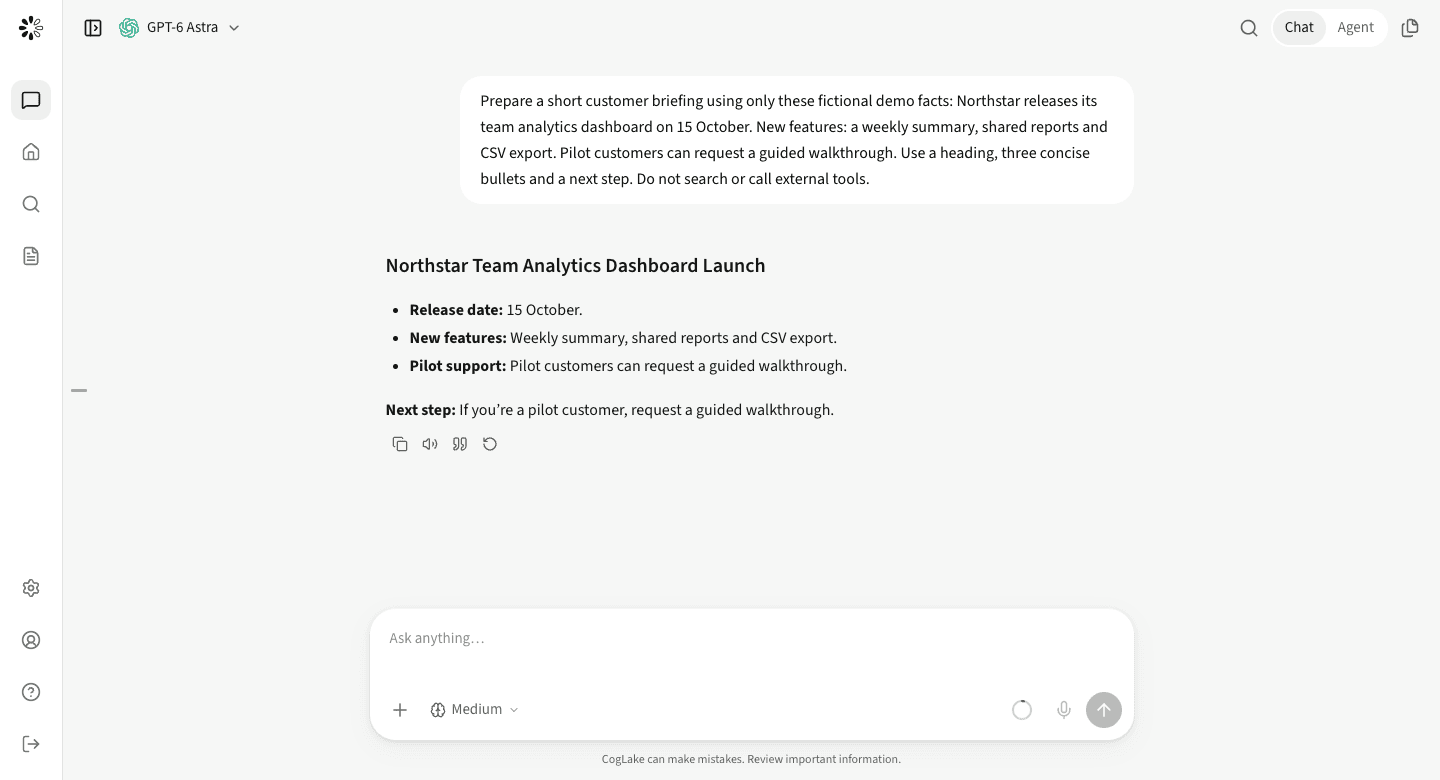
Start with a conversation
Familiar chat. Context that belongs to your business.
Ask a question, attach a document or image, and research the web. Choose an approved model for the task while your company knowledge stays connected through permission-aware access.
- Conversations, projects and files
- Web search and model-supported image inputs
- Sources and usable document results
Agent Mode
Give an objective. Follow the work.
Let an agent research, use tools, work with files or run code in an isolated environment. Inspect its work log and approve actions when your policy requires it.
- Research, browser use and isolated execution
- Tools, MCPs and specialized skills
- Clear approvals and traceable results
- Brief
Summarize the changes to our product offering and prepare a customer briefing.
- Context
Read authorized product documents and current notes from the wiki.
- Result
Create a sourced briefing and make it available for review.
Personal agents
A working relationship, not a one-off prompt.
Create a dedicated agent with instructions, memory and its own workspace. Continue the conversation, schedule routines and return to its saved progress.
- Persistent workspace and memory
- Routines, checkpoints and task continuity
- The same central access and model policies
Agent workspace
Instructions
Saved progress
Files and results
Continue the task instead of rebuilding the context every time.
Automations
The right task. At the right time.
Choose a trigger, give clear instructions and select the skills or services the agent may use. Run it manually to test, then inspect each execution in the run history.
- Schedules, intervals and one-time runs
- Webhooks, HTTP and connected events
- Manual tests, pause controls and run history
- Every weekday · 08:00Europe/Berlin
- Prepare a product briefingKnowledge sources + approved tools
- Review the resultApproval according to policy
MCPs and skills
Give your agent the right tools for the job.
Discover services and skills from connected libraries. Add personal resources or use centrally configured company connections without repeating the same setup for every employee.
- Searchable MCP and skill libraries
- Personal and company-managed connections
- Permissions and approval policies before actions
Models and providers
Your models. Your operating choices.
Use centrally provided models, bring your own API keys or connect your own inference. Administrators decide which providers and models are available to each organization.
- OpenRouter, OpenAI, Anthropic and Gemini
- Ollama and vLLM for your own inference
- Provider controls, usage visibility and BYOK policy
 ChatGPT
 Claude
 Gemini
 Mistral AI
Results, not just responses
Keep the work. Review it where it happens.
Open documents, spreadsheets, PDFs, images and code beside the conversation. Download the result or add an authorized artifact to the Knowledgebase.
- Office, PDF, tables, media and code previews
- Static HTML previews with restricted execution
- Downloads and permission-checked knowledge handoff
Review, download or add to the Knowledgebase with the required permissions.
Good to know
Frequently asked questions
How do chat, agents and automations differ?
Chat is for direct conversations. Agent Mode handles multi-step tasks. A personal agent retains its workspace and memory for ongoing work. Automations start defined tasks on a schedule or event.
Can employees use their own providers?
If company policy allows it, employees can add personal API keys and resources. Administrators can restrict provider access and offer centrally managed connections instead.
Does an agent act without asking?
That depends on the selected approval mode, allowed and denied actions, and organization policies. Required approvals appear in the conversation; central restrictions cannot be bypassed by the user mode.
Is model usage included in Knowledgebase pricing?
The AI Workspace is an additional product. Its commercial scope and model usage are agreed separately. BYOK usage is billed by the connected provider under your own agreement.
Start with your use case.
See sources, access controls and a relevant workflow together, not as an isolated list of features.